Active Voice #1: Pardal
This article is part of the “Active Voice” series, a collection of writings about popular participation tools, the author’s own experiences and some public data analysis. Visit the #active-voice para ler mais.
Series Debut
In one of the greatest popular movements in Brazil, Lula got reelected for his 4th term. In his winning speech, he said:
[…] we’ll change the way we rule the country. We’ll make people participate more in our decisions.
That got me thinking of how much the people already participate or not in the government. Here on the blog I’ve already written about some instruments that the citizens can use to talk to the state, but I felt like diving deeper into some of them. Let’s go✊🏼!
Pardal TSE
What is it?
The Superior Electoral Court (TSE, in Portuguese) supplies an app called Pardal which we usually only remember every two years1. According to them, it:
[…] is a tool from the Electoral Justice that allows a citizen to communicate irregularities related to the electoral ads identified during the campaigns. The initiative is aimed at strengthening people participation, transparency and honest electoral process.
It sounds great, a perfect for this series, an app to connect the citizen to the electoral process and guarantee that everything runs smoothly.
How does it work?
With the app installed on your phone2 the interface is very intuitive, you just describe the report in text or audio, then the app analyzes it and tries to automatically categorize it into an appropriate violation3. With that done, you only indicate where the situation occurred, who was the candidate or party involved and which evidence you have (pictures, videos, audios). Filing a report is straight forward!
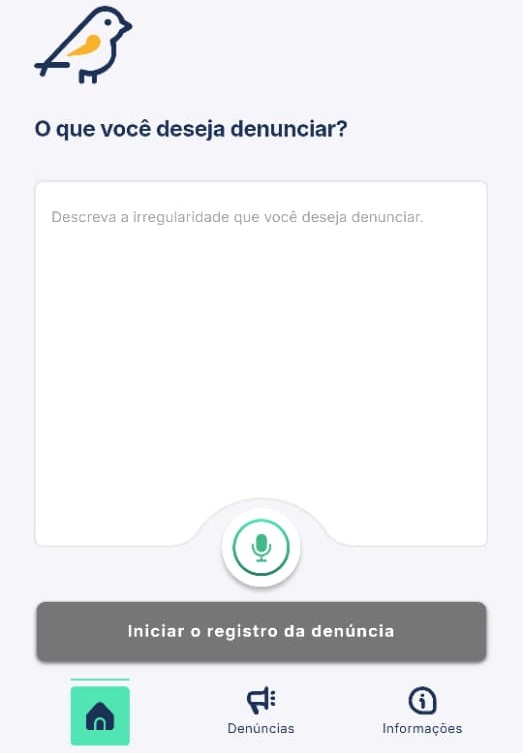
Screenshot of the Pardal app initial screen
Do people use it?
Data about the reports are supplied at every election and it’s on them that I’ll briefly support my reasoning to try and answer this question. I tried looking into the data of all “Federal Elections”4, but since Pardal is relatively recent, this only gave me insights about the last three.
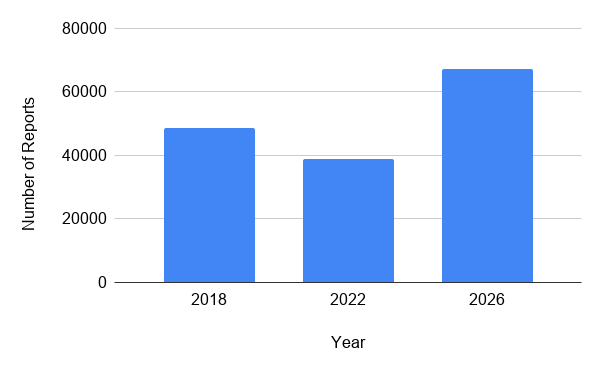
Report submitted to Pardal over the last 3 elections
It’s possible to see the total number of reports and among them, how many were closed and how many were petitioned5. The total number of reports doesn’t seem to yet have a pattern6 and led me to several questions:
- Why does 2018 have 25% more reports than 2022? Is it because it was the year that Pardal debuted and was more heavily promoted?
- Did people stop believing it in 2022?
- Why did reports grow 73% in 2026? Greater people mobilization, increase in fake news or all of them combined?
Nevertheless, counting the entirety of the 2026’s elections first round there were only 67 thousand reports, that is, only 0.04% or 1 in every 2360 voters reported something7. It’s unlikely that the elections are that honest, so I’m led to believe that people just stopped reporting, but why?
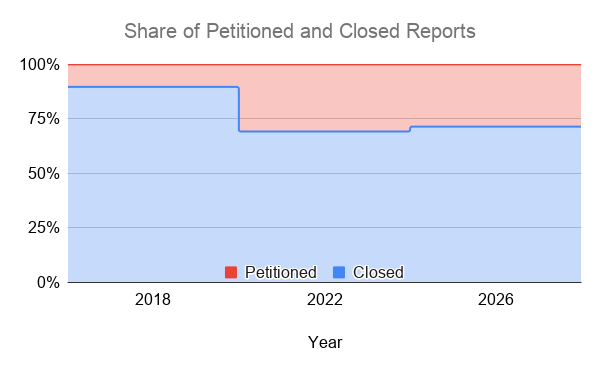
Analysis outcome of each report submitted to Pardal over the last 3 elections
Only 30% of all reports filed are ever petitioned, so the majority is closed without any further analysis and that likely demotivates people to file new ones, which is a perfect hook to tell my own story.
My experience with Pardal
I had used the app plenty of times in previous elections, especially to report irregularly placed propaganda on the streets, which is what kept happening this year. One day I was cycling on one of the few bike lanes of Belo Horizonte and stumbled upon this:

Wind Banner of a candidate right in the middle of a bike path
The famous wind banner was literally in the middle of the way. Could I dodge it? Of course, specially because the bike path is not usually crowded, but according to the app, its placement should follow these rules:
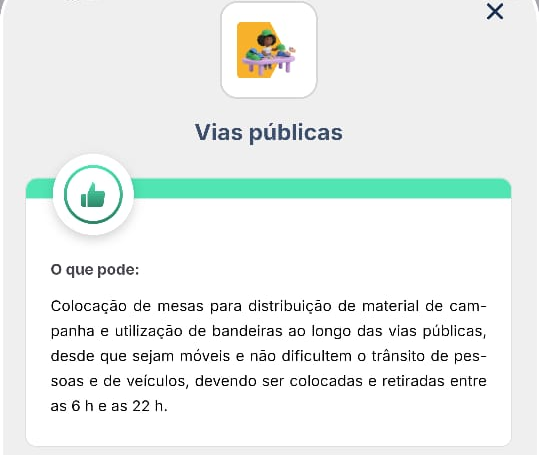
Rules on what can be put into the public streets, showing a small text of what is legal such as wind banners, so long as they don’t stand in the way of people and vehicles
As it was obstructing the way of people and vehicles, I thought it would be a fairly obvious report and submitted it. I must add here something I later found out: the app only offers you that text box and then it sends it exactly as written there, with no confirmation steps to edit it later. In any case, my first attempt was succinct and said something along these lines:
Misplaced propaganda blocking the bike lane on the central traffic island where streets X and Y intersect
When filing a report, you get an e-mail confirming it was filed and showing you how to track it. One of the system’s shortcomings is that it will never notify you again if the report is ever updated and you can only find out by periodically clicking. Anyway, I’m one of these annoying people that follow this stuff, so a few hours later I noticed it had been closed with the following explanation:
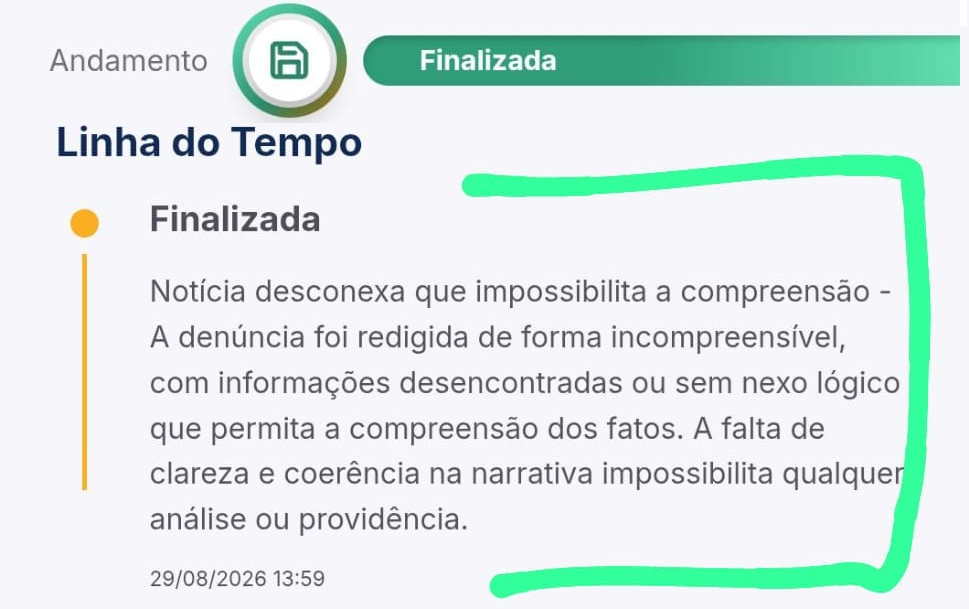
Result of my first report: closed with a text that in summary explains my report was incomprehensible, not cohesive and disconnected
My report was succinct, but it felt wrong to say it was incomprehensible, so I tried again with a few more words. Another hour went by and I got another answer:
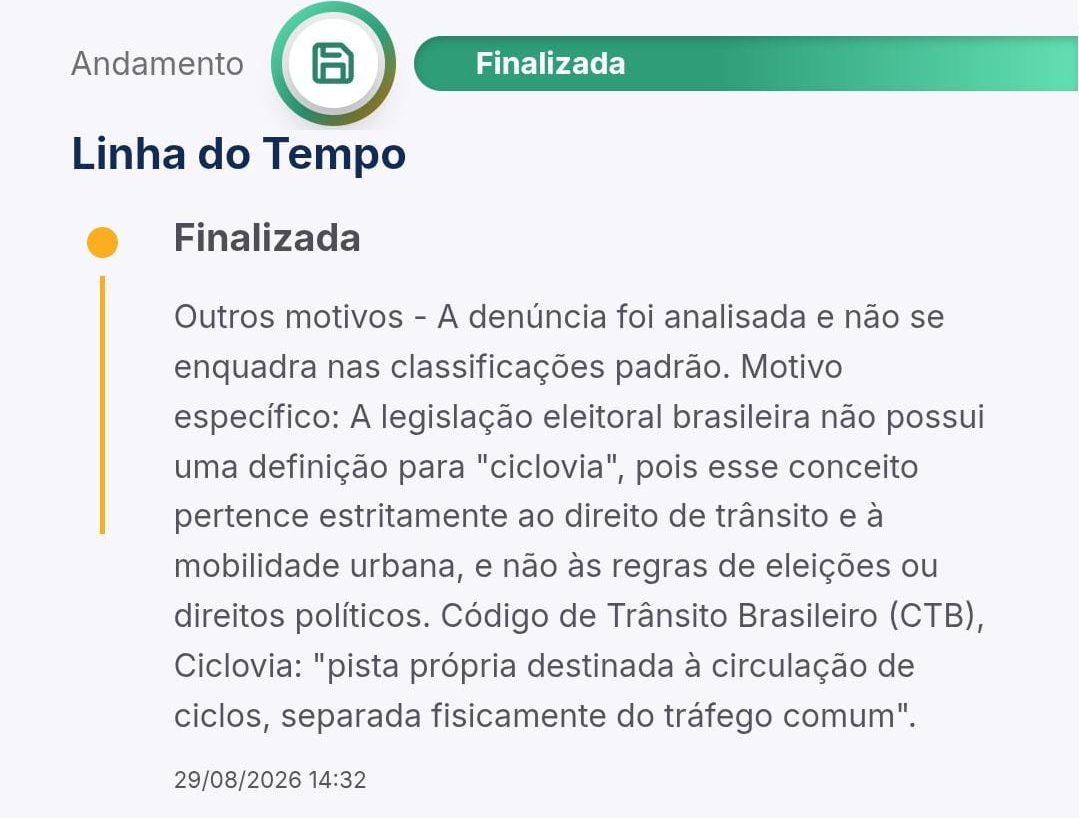
Result of my second report: closed because the election laws do not define what a bike lane is, but rather the traffic laws, and as such it was not breaking any election rule
How come it was rejected based on claiming that the election laws didn’t have a definition for bike lanes? Of course they wouldn’t, since they define rules for elections. At this moment, I realized the reports were being misjudged in bad faith, so for my third attempt I recruited ChatGPT to supply the appropriate legal lingo to counteract the previous explanation.
Finally the report was petitioned, third time is the charm, right? A person went to the place I reported to investigate, but said there was no wrongdoing and once again closed the report 🤷🏼♂️.
Conclusion
Does reporting matter? On one hand, it doesn’t, I need to be very pushy to get them to at least investigate my report and I figured a lot of people would give up sooner. On the other hand, it does, as it ends up being a good way to ask the government to do more, as well as finding out what is available to us in a way that we can know what to ask next.

AI-generated image with the prompt “Gere uma imagem mostrando um juiz cujo sexo não está definido parecendo desclassificar arbitrariamente as denúncias vindas de um aplicativo que tem o ícone em anexo e os cidadãos ao fundo com cara de confusos. Escolha o estilo que parecer melhor, desde que a imagem não pareça muito poluída”, using ChatGPT.
My experience with Pardal was bad, I filed a lot less reports than compared to the past election, but on the upside I also saw less obvious violations of the election laws. Curiously, while writing this text and researching, I found out that two weeks after my quarrel, TSE published rules for wind banner placement and, to my surprise, here is one of its items:
forbids the installation of them on roads, bike paths and lanes […].
I don’t believe that it was my doing that led to those definitions, but I like to believe that pressing on with these instruments sometimes can lead to a positive change.
Since it doesn’t take a lot to do it, I’ll keep trying 😊
Which is the frequency that we have some election (municipal or federal). ↩︎
Just for Android and iOS. ↩︎
You can change it if you disagree. ↩︎
The ones were we vote for presidents, governors and more. ↩︎
It’s also possible to see the number of ongoing reports, but since it’s an irrelevant share of the total, I omitted them. Também é possível ver o número de denúncias ainda em andamento, mas como é uma fração irrelevante, omiti aqui. Oddly enough, some reports from 2018 are still in this state (???) ↩︎
Obviously ignoring the fact that it is still too short of a series to have statistical relevance. ↩︎
Brazil has around 158 million votes, according to TSE. Technically anyone with a government-issued login or voter ID can file reports, so the proportion would be even worse, but I simplified it to only voters and one report per voter. ↩︎