Belo Horizonte, where's my tree?
My relationship with the Belo Horizonte City Hall (often abbreviated PBH) is complicated: on one side I love tools like the BH Map1 and the ease at which we can request MANY services online2, on another it is frustrating that there is so much inconsistency in the services being done and that some great projects never come to life.
The idea behind this article was born out of the frustration with a service and then grew as I found the “Belo Horizonte’s Municipal Plan of Afforestation” (PMAU-BH) on my searches. Overall I think it’s an interesting story, especially if you live here, so let’s get to it!
Túlio and PBH’s Service Portal
Origin
For some reason I always knew it was possible to request different services from the city hall (PBH) on their website, but up until 2002 I had never used it for anything else other than identifying myself for violating a few traffic laws3.
In 2022, with the end of the global pandemic and the return to office, I started filing several complaints about buses being overcrowded, since it was common to lose a few because I could not get into them. Initially, the replies were good, things like “we’ve notified the company responsible” or “the timetable will be reviewed”, which gave me a faint hope that something would be done.
Over time, the new requests started being dismissed for not containing the number of the vehicle. I understood then that their posture had changed and they were looking to blame the driver for the overcrowding, rather than reviewing the lines and their capacities4. Do you see now how the relationship is complicated?
In the same year, I registered that the street where I lived was seeing a lot of car accidents by the corner, as it seemed that many drivers were not seeing the STOP sign there, so I requested it to also be painted on the ground. The response I got was:
[…] after surveying the area, we propose painting the STOP on the ground, a pedestrian crossing, parking lines and the saying “SLOW DOWN 30km/h”, aside from warning signs of the mandatory stop.
It overcame any expectation I had, since they not only did what they wrote, but also installed a speed bump, so I felt my own safety as a pedestrian had increased5. It was the faith in the public service slightly restored.
Stump Removal and Planting
A year later, 2023, I saw a post on Instagram from the Bora Plantar collective6 which explained how to ask for trees to be planted onto the city’s sidewalks and the removal of tree stumps to later allow for new ones to be planted. I thought this was very cool and really motivating, I even commented on the post back then that I didn’t know the city hall did the removal of tree stumps7.
Since then, every time I was wandering around the city I would take note of empty plant beds or tree stumps on Google Keep and make a request. Yes, the response and execution time varied wildly, usually there were three ways the request would be answered:
- Most would be like “recommend the planting of X8” or “planting can’t be done according to DN69…”. I even recommend you see their Tree Planting Guide, if you know Portuguese, it’s very well explained and illustrated.
- Some would only return with “planting done” or “denied”.
- Once I got a thorough analysis of the whole street - where it was and wasn’t possible to plant, the reason why and all of the recommendations. This response was great for me for two reasons:
- To show that there are competent and willing people in the public service, contrary to popular belief.
- To show me that I could request trees to be planted even if there weren’t existing plant beds, as the city hall might open up a new one!
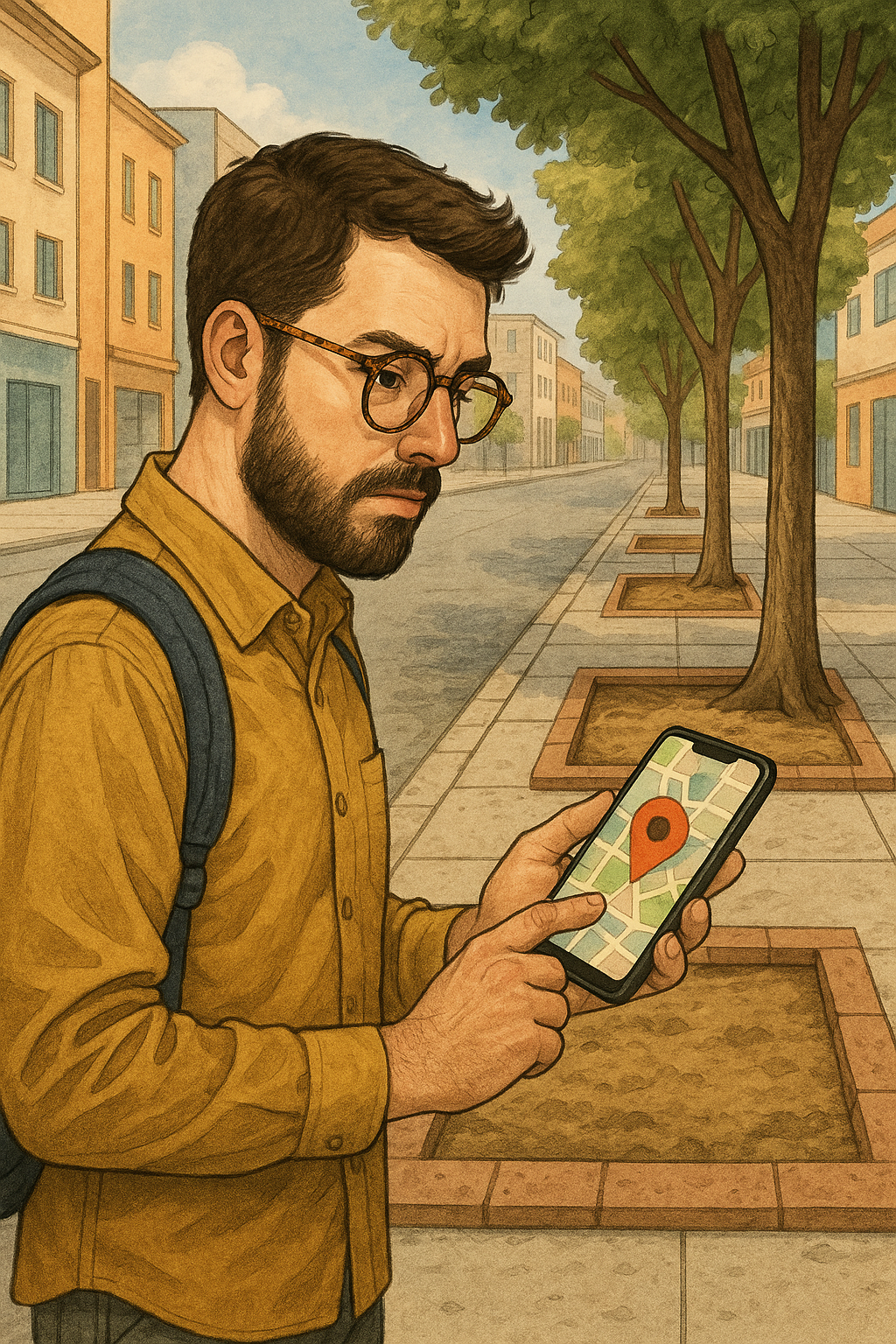
Image generated by AI with the prompt “Uma ilustração de um homem de 30 e poucos anos, barbudo e usando óculos redondos com textura de tartaruga olhando para um aplicativo de mapa no celular e fiscalizando canteiros de árvores vazios pelas ruas de Belo Horizonte, Minas Gerais - Brasil.” using ChatGPT.
Since then I made around 200 requests and, as a good citizen, followed them closely, including going to the place to verify that the service had been done9. I had a success rate of roughly 70%10 and I like to think that, at least on the Gutierrez neighborhood, I made some difference for the upcoming years:
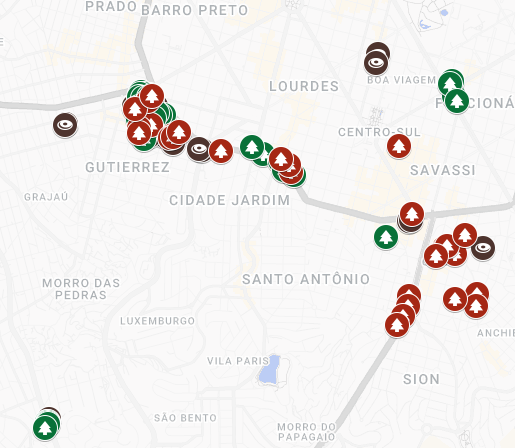
View of all the requests made. Green trees are plantings done, red are denied ones and brown holes where the tree stump was removed
The end?
At some point in March of 2025, the page to request new trees was heavily updated. Among some improvements there was the capability of specifying how many trees were being requested, as well as choosing a specific species, both welcome changes as I would have to type less. I was not counting, however, on the third change which was requiring the attachment of the municipal property tax of the property at the given address.
I was devastated, this change would end my hobby of trying to afforest the city, limiting it only to my properties11 and the squares or central plant beds, usually already with enough trees. I understand that the responsibility for the sidewalk is of the owner of the property and that many think trees will damage it 12, at the same time I know most of them will not oppose to the tree being planted, nor will they ever file a request for it to be done, for lack of interest or knowledge13. The lack of a centralized planning, in my opinion, will only lead to a city with a decreasing number of trees.
The PMAU-BH
While dealing with the frustration of not being able to request new trees to be planted, I stumbled upon the “Belo Horizonte’s Municipal Plan of Afforestation”, as stated in the introduction. Recently showcased to the city community, it is a 200-page long document that covers everything from the history of tree planting in the city until the detailed planning of the next 5 years. For the ones interested in the theme, it’s quite an interesting read, be it to get a hold of what is being planned and be able to participate and demand it to be executed or to find out all of the species we have in t he city and which ones cannot be taken down.
From my brief reading, I chose three topics to dive into: continuity of the planting, rain gardens and the program “Adoro BH” (I love BH).
Planting and Existing Trees
According to PMAU-BH (page 42), one of its specific goals is to::
III. Promote the expansion and maintenance of the urban tree coverage."
It is an excellent goal, since as seen on table 8 (page 180), Belo Horizonte (BH) has around 550 thousand trees and needs an additional 400 thousand to get to the desired coverage level. A few questions arise:
- BH has an area of 331km² (IBGE), but only 7,4km² (2%) are parks (page 55)14. Some impressive data: Barreiro is the largest region in the city and has only 5 parks (0,4km²) while the East region has a single park of 0,04km².
- According to PBH’s “Treemeter”, a hundred thousand trees were planted since 2020:
- Half of them were planted on Pampulha which, according to Table 9 (page 180), historically already has double the tree coverage of all other city regions. It’s fundamental to look beyond the raw numbers, as it would be possible to “overplant” on Pampulha to get to the desired metrics without touching any other region.
- In the first 6 months of 2025 only 2800 plantings were done. If the average is kept, it will be the year with fewer trees planted since the beginning of the series, in 202015. Not a good start for the PMAU.
- 22 thousand trees were removed since 2021 and 123 thousand were pruned (page 86), usually drastically which leads to their removal later. This makes it even harder to get to the proper tree coverage.
- According to the PMAU the planting is usually done either by citizen request or environmental compensation16 (page 83). Only 4 thousand plantings were done by request since 2020, a number that is bound to go down now that the proof of ownership of the property is a requirement.
- 45% of the existing trees are exotic (page 125) and despite there being measures planned to contain them, tables 19 and 20 (pages 199 and 202), the city hall continues to grow 20% of exotic species among its tree saplings (page 75). It’s urgent to reduce this percentage on the tree nursery in favor of our native flora17.
Therefore there is a lot to be answered and questioned on the PMAU with regards to the maintenance and expansion of the trees in the city.
Rain Gardens
Another project listed on the PMAU-BH is the one about installing “rain gardens” over the city (page 92). They’re basically small gardens on the street with exposed soil that allows the rainwater to infiltrate, preventing it from flowing and accumulating, causing flooding.
I’m very much in favor of the project18, since it increases the city’s greens and can mitigate the impact of the heavy rains. Interesting to note that the project contains a mechanism to allow citizens to adopt the gardens, to keep them alive, clean and working, with an added benefit of up to 10% discount on the municipal property tax. A year ago, the program’s success was being commemorated given that there were 64 rain gardens and 113 people willing to adopt them, showcasing community interest to expand the project!
The current status is not so exciting, though, as a year after the news about too many requests, 50 of them still remain available. I would love to understand if it is due to the city hall bureaucracy, if people give up or if the requests are denied because the applicants do not fill the minimum criteria, like living on the same street as the garden. Adding to that, the project writing stated an additional 200 gardens would be done every year, but two years later there are still only the original 64. I’m thinking that they will argue that there is lack of interest from the citizens, despite there being a public interest.
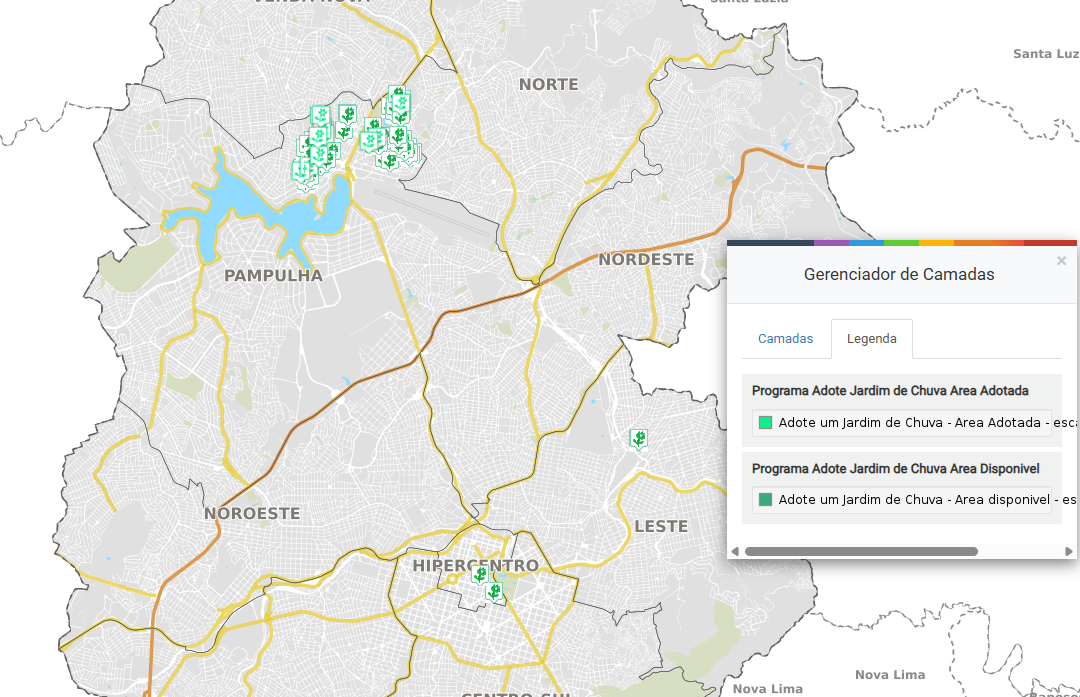
Belo Horizonte map with the location of the adopted and available rain gardens.
Finally, the project was again only done at Pampulha, on “spaces with […] predominantly residential areas and low vehicle prevalence”. Although positive that it was done on peripheral neighborhoods, usually not adopted by such environmental programs, it was still done on the region with the most tree coverage of the city. The expansion of the initial project into other regions that suffer from flooding and that had different characteristics would have been very important to compare citizen’s adhesion to it.
Adoro BH
The last project I want to highlight from the document is the “Adoro BH” (page 92). It states that any person or company can adopt a public space to help on its conservation19 in exchange of affixing a pane with the name of whomever did it there. In addition, it also foresees the expansion and creation of new public spaces, green areas and water resources/bodies, but there isn’t much information if that has ever happened voluntarily.
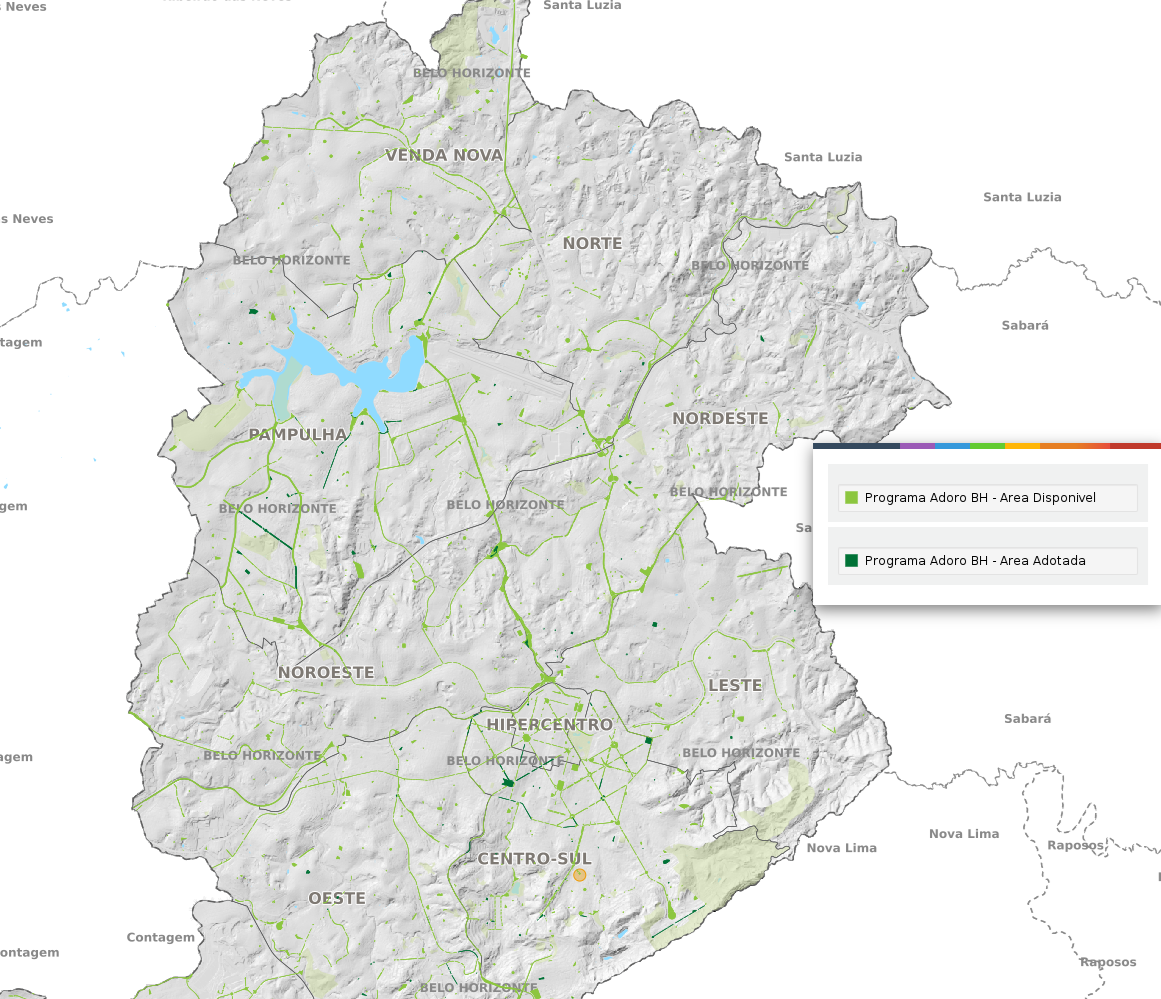
Belo Horizonte map showing available and adopted areas via the Adoro BH program
As seen on the city hall’s own map, despite the program being in place for two years, it doesn’t seem to have been picking up speed, I believe due to the small benefits to whomever does it.
Final Thoughts
When I started writing this text, more focused on my hobby of requesting trees to be planted, I never thought I would end up spending a few hours of my free morning reading the afforestation city plan. Coincidentally, I pondered about talking on this subject several times and didn’t, but picked just the time when PMAU had been released. Funny, huh?
Currently I’m very skeptical about the changes still to come, especially due to the lack of progress on the documents I have highlighted. Yet, even though I’m being pessimistic, I made an extra effort to state every page and link where the information I quoted came from, because I believe the plan was well elaborated and, if we have more people interested in understanding and following it, we might have success.
Let’s supervise, audit and hope 😊.
It’s an interactive map where you can see different information about the city, from garbage collection schedules, through building data up until the distribution of antennas in the city. ↩︎
Sadly one still can’t request a pedestrian semaphore to be fixed neither online nor by phone, as I realized from my last attempt. ↩︎
It’s on the service portal that you make a request to identify who the lawbreaker was in case of a fine, which I had some in the pandemic when returning home a bit too fast 😓. ↩︎
Speaking of urban mobility, have you checked the campaign for free buses in Belo Horizonte? ↩︎
I still saw an accident after that, but if not even a semaphore solves it in some cases, it wouldn’t be the preventive signage that would fix hehehe. ↩︎
Which I now realized was also present at a seminar about the plan that I attended at the municipal chamber on 07/02/2024. ↩︎
I was harassed by a person saying it really was not possible, as the city hall would never do it. Like a good straight man, this challenge motivated me even more. ↩︎
I even saw our endangered “pau-brasil” once! ↩︎
Recently I was even using the “public bikes” to do so, in what I affectionately nicknamed the “Tree Patrol”. ↩︎
Several are still ongoing. Like I said, the response time can be very unpredictable. ↩︎
Which in this case is a single one. ↩︎
34% according to PMAU-BH (page 153). ↩︎
Once a request was denied because the owner of the store told the worked that “the tree will cover my shop’s sign when it grows” 🫠. ↩︎
I’m trusting that ChatGPT did the math right given table 1 (page 55). ↩︎
That’s even considering that the services on 2020-2021 were slower due to the global COVID pandemic. ↩︎
It is very common for new developments in the city to be obligated to plant trees somewhere as compensation for removing some where the development is being done. ↩︎
For more details about valuing the native species, I recommend following the biologist Ricardo Cardim. ↩︎
My brother too, as he informally adopted one in São Paulo, right Tapas? 😊 ↩︎
“Liberty Square” (Praça da Liberdade), for example, is available! ↩︎